Case study · Infrastructure products

An infrastructure products group now runs reviews from trusted data.

Carric connected separate divisional ERPs through a governed operating layer. Leaders compare products, inventory, orders, and performance while each source system remains authoritative.

Aerial view of an infrastructure products yard organized around one central dispatch corridor
Client
Multi-division infrastructure products group
Operation
Cross-division operating review
Systems
Divisional ERPs and reporting sources
Decision owners
Division leaders and data governance

The operating constraint

Leaders had one report. Each new question sent analysts back to the ERPs.

One of our clients is a multi-division infrastructure products group. Each business runs its day-to-day operation in a separate ERP. Those systems correctly reflect local products, units, customers, inventory, orders, and financial records.

Group leaders still need one view across the portfolio. Before Carric, every operating review required exports, mapping tables, spreadsheet adjustments, and conversations with division experts. The report could be consolidated, but its business meaning and source lineage were hard to inspect.

Before

Analysts rebuilt mappings for each group review.

  1. ERP data exported
  2. Mappings rebuilt
  3. Definitions checked
  4. Questions sent back to divisions
After

One governed layer now links the values while each ERP stays in control.

  1. Source records retained
  2. Mappings prepared
  3. Owners confirm meaning
  4. Group view refreshes with lineage

The working system

See what the system looks like.

Follow one product conflict through two role-specific views. The data steward sees what blocks the next group review. The divisional owner sees the source evidence and retains approval authority.

01 / 02

The data steward sees which conflicts could change the next group review.

The queue shows the affected record, consequence, owner, due date, evidence state, and current decision stage.

Divisional Operating Intelligence reconciliation queue showing data conflicts, owners, due dates, and evidence states

Swipe across the screen to inspect the full interface.

The new operating path

Each shared value now keeps its source, definition, owner, and approval.

The operating layer creates a governed relationship across records. It never replaces local transaction systems or changes divisional business meaning without approval.

  1. 01

    Each ERP retains the local record.

    Products, units, inventory, orders, and metrics keep their local identity and source authority.

  2. 02

    Carric prepares the group mapping.

    Candidate mappings show the source evidence, transformation, conflict, confidence, and reporting effect.

  3. 03

    The division confirms what the data means.

    The business owner approves, returns, or escalates the proposed relationship.

  4. 04

    The group view refreshes with lineage.

    The approved value enters operating reviews with its source, definition, owner, and change history.

Human authority

Carric prepares the mapping. Division owners approve what the data means.

Data governance controls the mapping and lineage. The source records remain unchanged.

What changed operationally

Group reviews now use reconciled evidence, not rebuilt spreadsheets.

Leaders get a consistent cross-division view while local teams keep control of the systems that run their operations.

01

One trusted group view

Products, units, inventory, orders, customers, and measures become comparable across divisions.

02

Local ERPs stay in control

Each ERP still owns its transactions and local operating records.

03

Every value keeps its lineage

The group view carries the source, transformation, definition, owner, and approval state.
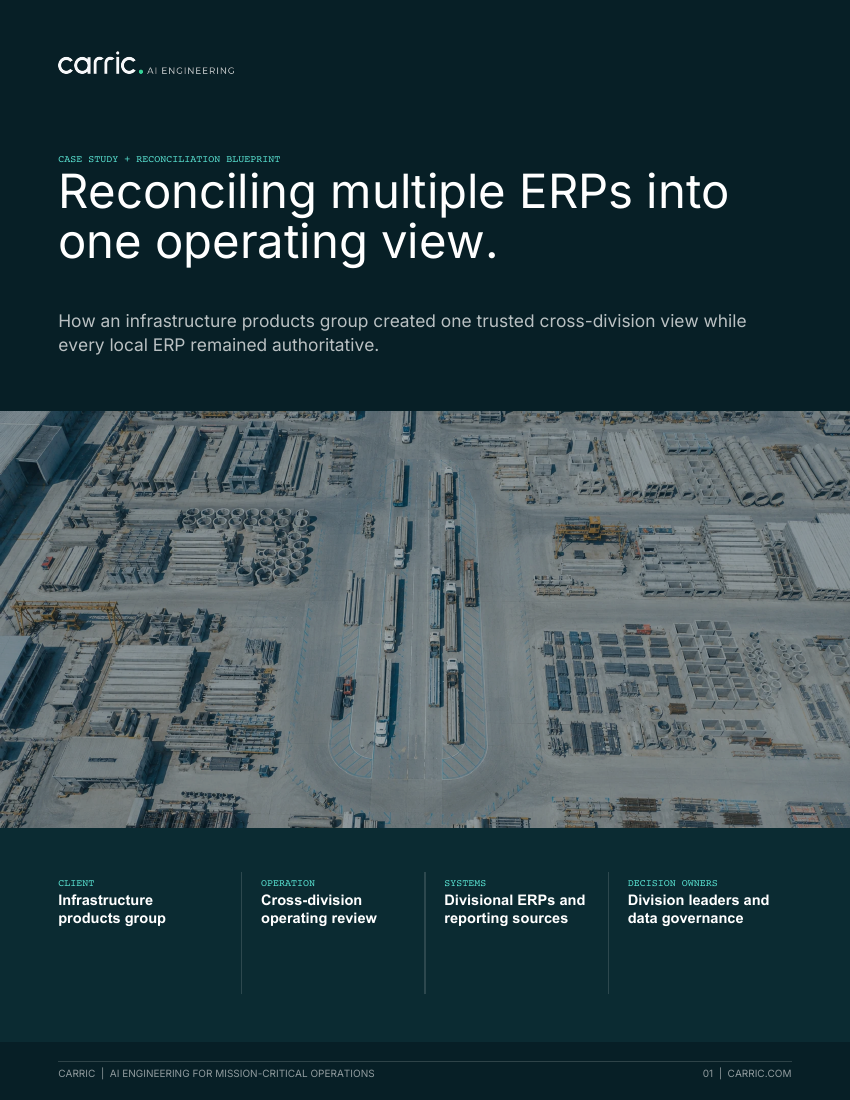
Cover of the Multi-ERP Operating Intelligence case study and reconciliation blueprint PDF

Downloadable case study

Get the full case study and operating blueprint.

The six-page PDF includes the old and new operating paths, the role of each system, both product views, and a checklist to find the same pattern in your group reporting.

  • The reporting constraint and the conflict that exposed it
  • The governed path from local records to a shared operating value
  • Questions to assess a similar multi-ERP environment

The case study remains open. By continuing, you agree that Carric may contact you about this operating pattern. Privacy policy.

A similar operating pattern

Which group review still sends your team back to the source data?

Bring one cross-division measure, the ERP records behind it, and the decisions it supports. Carric will help determine whether it is the right starting point.

Book a 30-minute fit call No formal brief is required.